
We could not resist heading to the Rendezvous for ribs. Well, maybe not we, but I! They are unofficially open for lunch, which means you can get ribs, beans, and slaw. Leon had a nice Greek salad.
 We later located a delightful spot on the shores of Kentucky Lake in Piney Campground at Land Between the Lakes. This is a 40 mile long peninsula that is a National Recreation Area between Kentucky Lake and Lake Barkley, the southern half lying in Tennessee.
I couldn't resist a geocache located several miles from our camp. It led us to the Bear Spring cold-blast furnace near Dover, TN that was used until 1901. What an education.
The first one was destroyed in the Civil war and this was the replacement. This furnace, built of limestone, produced pig iron from the brown hematite ore found in the area. Charcoal made from the abundance of timber in the region was used for the fire. Temperatures often reached 3,500 degrees. A find like this is what geocaching is all about to us!
 Fifty years ago Leon was stationed at Ft. Campbell, Kentucky, only an hour's drive from our campground. On 9/11 we were ready for an adventure. He had spent a lot of time in Clarksville, Tennessee and wanted to look for his old haunts again. Sure enough there was the Roxy Theater and Frank's Place, two that he recalled vividly.
I enjoyed visiting with this fellow who was reading the newspaper founded in 1808 and showed him the new way to go - my iphone!
 The museum is in an attractive old building that was once the 1898 Old Federal Building.
After a stroll on the riverwalk alongside the Cumberland River we visited the home of the 101st Air Assaut Division of the U.S. Army. Here Leon reminisced about his home for 3 years. We toured the Pratt Museum and he located a 3/4 ton like he used to drive.
Then there was the 105 mm Howitzer like the one he learned to fire in Ft. Chaffee, Arkansas.

This is a C 119 which is what Leon jumped from more times than he would have liked. It was also called a "flying boxcar." photo
 I thought this one looked like more fun!
 Several miles from our camp we stumbled upon Ft. Donelson National Battlefield. Ft. Donelson guarded the Cumberland River, which allowed Tennessee access to the Ohio River.
At first the confederates defeated the union army and disabled their ironclads.
 After some confusion the union army prevailed. Ft. Donelson is significant as the first major Federal victory of the Civil War was here. 13,000 confederate troops were taken prisoners of war and the towns of Bowling Green, Ky, Columbus and Nashville, Tn evacuated as a result.
It was dark when we arrived back at camp. If each day is as fun-filled as our first then we should be exhausted before long!
Is this better, Barb?


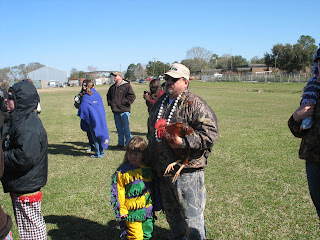
 From there we followed along the backroads stopping at several homes where someone would release a chicken for their gumbo. What craziness!
 They always gather and sing to the property owner, in French of course, and then after they catch the chicken they dance and beg for cinq sous or 5 cents. If you don't donate you might find your shoe gone.


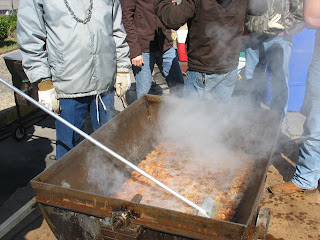
 We stumbled across a new rv park on the outskirts of town - Lakeview Park & Beach - and when we went to investigate were invited to stay as is the cajun way. They had a band playing and had started a boucherie earlier in the day. One guy was cooking a large pot of cracklins. He even pointed out the pig's ear!
 It was quite interesting to watch them stuff the boudin. One tourist commented that she heard they no longer use intestines for the casing but the cajun replied, "yeah, we do."





 I thought it was interesting that the sheriff stopped to play his accordion while in uniform. Must have been taking a little music break!


 The Jambalaya band played in their Mardi Gras costumes while Dr. Barry Ancelet from the Jean Lafitte Center narrated, mostly in French. The dance floor was filled with talented dancers.


 The pavillion in the Abita Springs park was designed for the Mississippi exhibit of the World's Industrial and Cotton Centennial Exposition of 1884 in New Orleans. After the exposition the pavillion was taken apart and reassembled in 1888 to cover the then famous free flowing spring.


